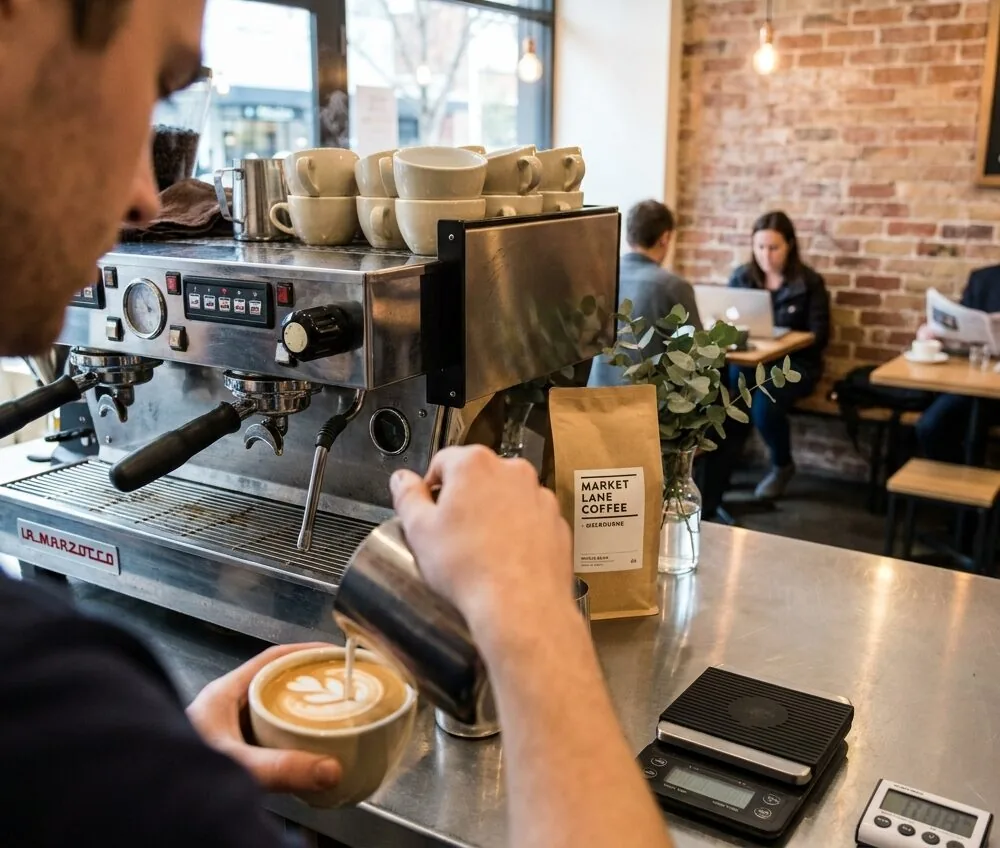
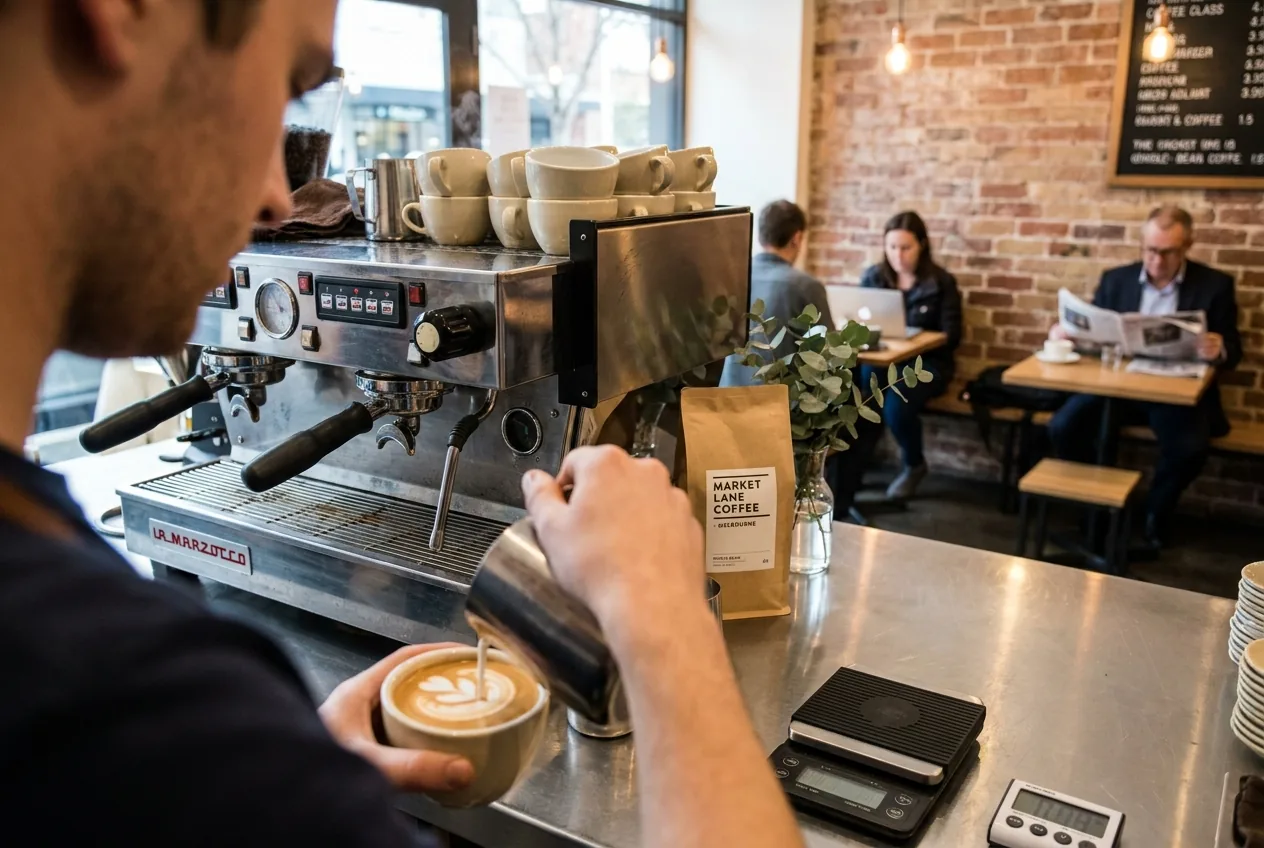
The typical best-coffee-in-Melbourne roundup is an SEO listicle: thirty cafes scattered across five suburbs, written for locals with cars and weekends, with no through-line a visitor could actually walk. This one has a route. This is a research briefing on a walkable laneway crawl through the Melbourne CBD, written from a desk in Casablanca, drawing on Sprudge’s specialty-coffee industry coverage, Broadsheet Melbourne’s cafe reviews, the Beanhunter community ratings database, Visit Melbourne’s tourism guidance, and the published roaster pages for Market Lane, Seven Seeds, and Maker Coffee. No partner links, no fabricated personal anecdotes, no padding to hit a word count.
The questions a real visitor actually asks about the best coffee in melbourne are simpler than most guides admit. Where do I walk. What do I order. What does it cost. What is genuinely worth the queue and what is famous-but-mediocre. We answer those, in that order, with sources you can verify yourself.
The headline answer: the best coffee in melbourne is a CBD laneway problem, not a five-suburb scavenger hunt. The melbourne laneway cafes inside the CBD grid are the highest concentration of specialty espresso anywhere in the Anglosphere; five named cafes in the right order over two hours, with named roasters, real prices, and an honest opinion about what to skip, is the form a useful melbourne coffee guide should take. A Saturday morning is enough. The rest of this brief is the working-out.
Quick facts
- Duration: 2-hour walkable laneway crawl
- Coffee cost (per cup): AUD 4.50–8.00 depending on style
- Best time: Weekday mornings before 10am
- Where to stay: CBD inside the laneway grid
- What to skip: Famous-name cafes that have declined post-2020
What most Melbourne coffee guides get wrong
The first mistake in most “best cafes in melbourne” articles is the thirty-cafes-across-five-suburbs format. Lists of that scale are useless to a visitor with two days. Fitzroy, Brunswick, Collingwood, South Melbourne, Carlton, the CBD — five suburbs is six tram trips and twelve hours, which leaves no time to actually drink the coffee. A visitor’s “best coffee in melbourne” question is a walkable-route question, not a comprehensive-list question. The honest version of best coffee in melbourne for someone with one morning is a sequence of five named cafes in the CBD laneway grid.
The second mistake is recommending famous-name cafes from the 2014-2018 melbourne coffee guide era that have since declined. The “best coffee in melbourne” listicles routinely lag the actual scene by three to seven years. Several of the cafes most cited in airline magazines and hotel concierge sheets have changed ownership, dropped their roaster, or coasted on reputation while the actual product weakened. Tourist-facing media rarely updates these lists, and the “must-visit” list a hotel hands you on arrival is often the list from 2017. Rule of thumb: if a cafe shows up only in tourist-aimed publications and not in Sprudge or Broadsheet’s last twelve months of coverage, treat the recommendation with caution.
The third mistake is writing for locals with cars and weeks of time. Visitors stay in the CBD, walk between stops, and have one or two mornings before their afternoon plans elsewhere. A useful melbourne coffee guide for visitors should be CBD-tight, walking-paced, and ordered as a sequence rather than a list. The same goes for any best coffee shops melbourne cbd article — visitor utility, not local completionism. Most published guides do the opposite.
The fourth mistake is skipping roaster context. A best cafes in melbourne shortlist that does not name the roaster behind each cup is doing the reader half a service at most. A cafe pours someone’s beans. The person who roasted those beans is part of the story — Market Lane roasts Market Lane, Brother Baba Budan pours Seven Seeds, Industry Beans pours its own. Coffee tourists care about who made the beans, and most listicles treat the cafe as the unit and forget the roaster behind it.
Why Melbourne is the coffee capital of the world
Melbourne earned its reputation by accident, then engineered it into a system. The accident was post-war Italian and Greek migration in the 1950s, which brought espresso machines into a city that had previously drunk instant coffee and tea. The engineering was the laneways: Melbourne’s 19th-century grid had narrow back-alleys for service deliveries, and by the 1980s those tenancies were the cheapest commercial leases in the city. A 15-seat cafe with a serious La Marzocco could open in a laneway and survive on AUD 4 coffees to office workers walking past. By the early 2000s, every second laneway had a cafe, and each new opening had to be better than the last to survive the density. Twenty years of compounded competition produced the current scene.
Most of the famous melbourne laneway cafes that anchor today’s scene trace their lineage back to a small set of original-1990s and early-2000s openings, and the durability of those cafes is part of why the city kept its lead even as Sydney and Auckland scenes matured.
The dairy industry was the third leg. Australia’s full-cream milk steamed into a micro-foam forgiving enough to carry a flat white — a drink formalised in Melbourne and Sydney in the 1980s and now the national default. The combination of espresso-knowledge, cheap rent, and good milk produced a system that has trained most of the senior baristas working across the Anglosphere; Sprudge‘s industry coverage tracks the lineage in detail.
The current city has roughly 4,000 cafes per Visit Victoria’s tourism data, and most are average. A small subset — the ones in this brief — are genuinely excellent, and they are the target on any best coffee in melbourne crawl. Coffee culture is durable here in a way it is not in cities where the scene was imported rather than evolved, which is what makes a current melbourne coffee guide worth writing in the first place.
Melbourne coffee terminology: a quick glossary
Order language matters. The cup sizes and drink shapes are fixed, and using the right name on the order is half of being treated like a regular. The core glossary:
- Magic. Three-shot ristretto in a 5oz cup of steamed milk, no foam. Melbourne-specific, pioneered in the early 2000s and now the order baristas pour for each other on shift. If you want to taste the city’s espresso-to-milk ratio at its sharpest, order a magic. AUD 5 to 6.50.
- Long Macchiato. Double espresso in a 6oz glass with a dollop of textured milk on top. Popular in the inner-north and Carlton; less common in the CBD. AUD 5 to 6.
- Flat White. Single shot, steamed milk with micro-foam, served in a 150 to 160ml ceramic cup. The national default. Originated in Australia and New Zealand in the 1980s. AUD 4.50 to 6 at most third-wave cafes.
- Cortado. Espresso with equal-volume warm milk, less common in Melbourne than in Spain or the US specialty scene. Some Brunswick and Collingwood specialty cafes serve it; expect a raised eyebrow in the CBD.
- Filter / V60 / Aeropress. Pour-over options, served black, single-origin almost always. Most third-wave cafes have at least one filter brewer running. AUD 6 to 8.
- Cold drip. Slow-drip filter brewed cold over 6 to 12 hours, served chilled or over ice. A Melbourne summer staple, less common in winter.
Sweet syrups (vanilla, caramel, hazelnut) are largely absent from third-wave Melbourne cafes. The drink is built around the bean. If you want the drink sweet, sugar is at the table; some cafes carry honey.
The walkable laneway coffee crawl: 5 stops, 2 hours, 1 morning
This is the route. Five named cafes in order, walkable, designed for a Saturday morning between 8am and 11am or any weekday morning between 7.30 and 10.30. Each stop is 20 to 25 minutes — enough time to order, sit, taste, pay. Total walking is about a kilometre across the CBD laneway grid. If you came to Melbourne to taste the best coffee in melbourne in a single morning, this is the structural map. The five cafes below are best coffee in melbourne picks under 2026 conditions, drawn from the most current Sprudge and Broadsheet coverage.
A note before the route: cafe quality changes. Picks below are verified May 2026 against Sprudge, Broadsheet Melbourne, and Beanhunter. If you are reading this more than six months after publication, cross-check before walking. Two of the five recommendations have operated for 15+ years; three for 10+. Roaster-owned cafes are the most durable picks for a list that has to survive its publication date.
Stop 1 — Brother Baba Budan, Little Bourke Street (9.00am)
Start at Brother Baba Budan at 359 Little Bourke Street, between Elizabeth and Russell. Opened circa 2003, owned by Seven Seeds and pouring the Seven Seeds blend, it is the longest-running of the laneway-era CBD cafes still recognisable from the early 2000s. The hanging-chairs ceiling installation is the famous photograph; the actual interior is a narrow standing-and-stool bar with a serious machine. Order a flat white or a magic to calibrate. AUD 4.50 to 5.50. Open Monday to Friday 7am to 5pm. Verified open and operating, May 2026.
Stop 2 — Patricia Coffee Brewers, Little Bourke + Little William (9.30am)
Walk west along Little Bourke for five minutes to Patricia Coffee Brewers at 493-495 Little Bourke Street, corner of Little William. Patricia is the most-named CBD cafe in current Sprudge coverage and consistently near the top of Broadsheet’s best-coffee-in-melbourne lists. Standing-room only by design — turn-and-talk over the bar, which keeps the queue moving. Patricia roasts and pours its own beans. Order an espresso; the standing format favours short drinks. AUD 5 to 6. Open weekdays 7am to 4pm, weekends 8am to 4pm. Verified May 2026.
Stop 3 — Industry Beans Lt. Collins, Little Collins Street (10.00am)
Cut south through the laneway grid to Industry Beans Lt. Collins at 345 Little Collins Street — Australia’s largest independent specialty roaster, CBD outpost. Twelve seats along a timber bench, a La Marzocco Modbar that gives a clear view of the extraction, a rotating single-origin filter list. Order a filter or a single-origin batch brew; this is where you taste the bean rather than the milk. AUD 6 to 8 for filter. Verified May 2026.
Stop 4 — Market Lane Coffee, Flinders Lane (10.30am)
Walk south across Collins Street to Market Lane Coffee on Flinders Lane (Market Lane has multiple Melbourne sites; the Flinders Lane location is the closest fit for this route). Market Lane is the carbon-neutral B Corp specialty roaster, and the cafe pours its own roasts across espresso, batch, and filter. Order a filter or a batch brew here too — the comparison against Industry Beans, ten minutes ago, is the lesson the entire crawl is teaching. Same drink shape, different beans, different roaster, different cup. AUD 5 to 7. Verified May 2026.
Stop 5 — Tom Thumb, Flinders Lane (11.00am)
Three minutes east on Flinders Lane to Tom Thumb at 53 Flinders Lane. Tom Thumb is 2.5 metres wide — wedged between high-rises and a carpark — and pours Clement Coffee’s Pony blend plus a rotating single origin. The pastries are by Matt Forbes; the bench is essentially the doorway. End the route with a sit-down flat white and a pastry to break the espresso fast. AUD 5 to 6. Current hours per the cafe’s social pages are weekdays 7am to 2pm with shorter Friday hours; verify on the day.
After Stop 5 you have done five named cafes, three different roasters, and the full espresso-to-filter ladder, all inside a kilometre of CBD laneway walking. That is the structural answer to “best coffee in melbourne” for a visitor with one morning.
Best CBD laneway cafes (a curated list)
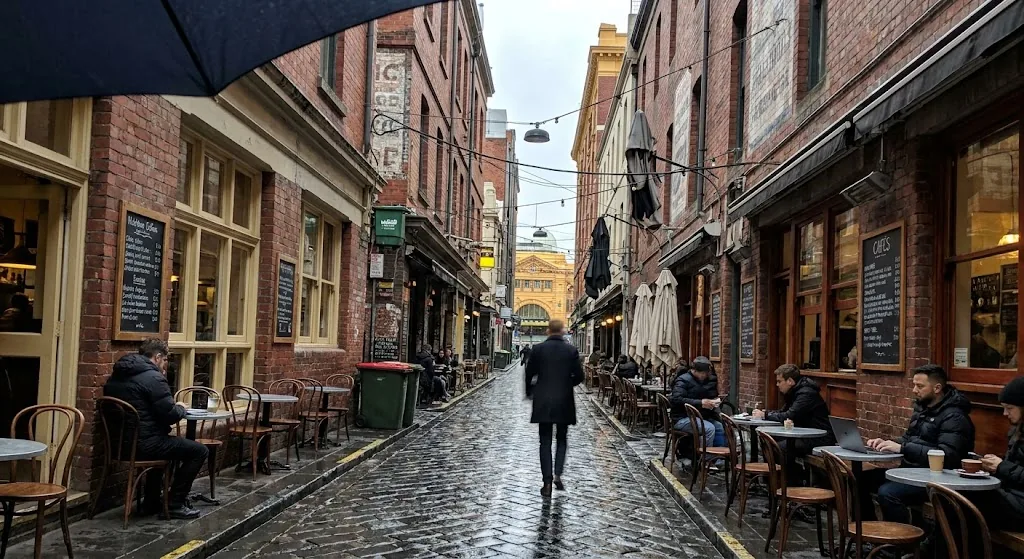
Beyond the route above, there are other CBD-tight cafes worth knowing. The list below is the curated best coffee shops melbourne cbd version of the broader “best cafes in melbourne” question, narrowed to CBD-tight melbourne laneway cafes. Grouped by what you are optimising for. All operating and verified May 2026.
Best for first-timers (forgiving, friendly, CBD-central):
- Brother Baba Budan — already on the route. Iconic for a reason.
- Patricia Coffee Brewers — already on the route. Standing format is part of the lesson.
- Maker Coffee (Little Collins Street) — single-origin focus, husband-and-wife operation, opened 2015. Sleek minimal interior, La Marzocco Modbar, accessible menu beyond espresso.
Best for purists (filter, single-origin, third-wave technique):
- Market Lane Coffee (Flinders Lane and Therry Street near Queen Victoria Market) — the rigorous-roaster choice.
- Industry Beans Lt. Collins — already on the route. The CBD outpost of the Fitzroy roastery; the Modbar shows the technique.
- Seven Seeds (114 Berkeley Street, Carlton) — strictly speaking just outside the CBD on the north edge, but worth the 12-minute walk. The roastery is a full-service cafe with a brunch menu and a meaningful single-origin list.
Best atmosphere over coffee quality:
- Tom Thumb (Flinders Lane) — already on the route. The 2.5-metre width is the headline.
- Hidden alleyway cafes off Centre Place and Degraves Street — the laneway photographs every travel magazine uses. The coffee is rarely the point of these stops; the people-watching is.
Best near major attractions:
- Market Lane Flinders Lane — three minutes walk from Federation Square and Flinders Street Station.
- Industry Beans Lt. Collins — two minutes from the Bourke Street Mall.
- Brother Baba Budan — six minutes from Melbourne Central station; close to State Library.
If you want the best coffee in melbourne beyond the CBD: Proud Mary in Collingwood (172 Oxford Street) ranked fourth in the World’s 100 Best Coffee Shops for 2025, and ONA Coffee Melbourne in Brunswick (22 Ovens Street) is the flagship of Sasa Sestic’s World Barista Champion roastery. Both 15 to 20 minutes by tram from the CBD; both are out-trips, not part of the laneway crawl.
Real cafe prices in Melbourne (2026)
What does the best coffee in melbourne actually cost in 2026. The tight bands at third-wave specialty cafes:
- Flat white standard: AUD 4.50 to 6.00. The lower end is common at older Italian-family cafes and roastery outposts; the upper end is new-wave specialty.
- Specialty single-origin espresso: AUD 5.50 to 7.50. Limited-availability beans, often a rotating list.
- Magic / Long Macchiato: AUD 5.00 to 6.50. Same as a flat white at most cafes; sometimes a small premium for the ristretto.
- Filter / V60 / Pour-over: AUD 6.00 to 8.00. The single-origin showcase. Worth the extra dollar to taste the bean.
- Alt-milk surcharge: AUD 0.50 to 1.00. Yes, still common in 2026 despite years of pushback. Oat is most reliable; soy and almond are usually the cheaper options.
- Pastry or breakfast item: AUD 6 to 12 for a filled croissant, AUD 14 to 22 for an avo-toast brunch plate.
- Take-home beans (250g bag): AUD 20 to 28 depending on origin and process. Roasted within 5 to 14 days of sale at most third-wave cafes.
Average per-cup-on-the-route for the 5-stop crawl above: AUD 4.50 to 8.00 per cup, AUD 25 to 40 for the full crawl with one pastry. Bring AUD 30 minimum, AUD 50 if you plan to buy beans.
A small percentage of inner-north cafes (Fitzroy and Collingwood specifically) prefer cash for transactions under AUD 10. Carry AUD 20 in notes for backup; everywhere else takes contactless.
Tourist traps to skip
Editorial honesty section. Be specific about the patterns rather than the names where possible — cafe quality changes faster than publishing schedules. The categories below are stable across the last several years; the names within them shift.
The “famous-since-2010 laneway cafe” category. Several cafes that featured prominently in 2010 to 2015 Melbourne-coffee tourism content have changed ownership, dropped their original roaster, or simply coasted while the inner-north and CBD specialty scene moved past them. These cafes still appear on hotel-concierge sheets and airport magazine lists; they rarely appear in current Sprudge or Broadsheet coverage. Cross-check any tourist-listicle recommendation against the Broadsheet Melbourne best-coffee guide before you walk to it.
The “Instagram-art-over-coffee” category. A subset of CBD and melbourne laneway cafes have optimised for the photograph rather than the cup. The latte art is genuinely impressive; the underlying espresso is mediocre. These cafes are easy to spot — the queue is for the photo, the regulars are not in the queue. Avoid if your goal is to taste the city’s coffee scene.
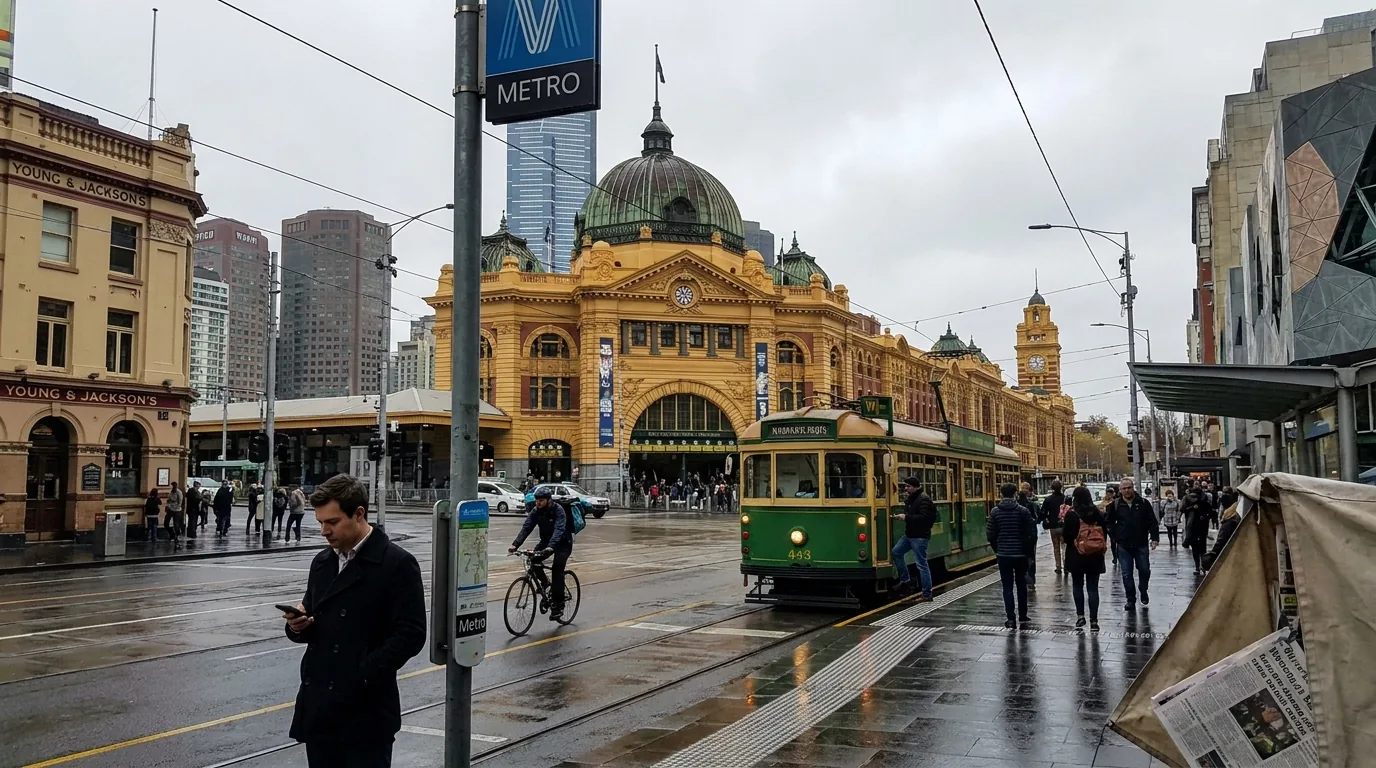
The “tourist-priced near Flinders Street Station” category. A handful of cafes within two blocks of Flinders Street Station charge AUD 7 to 9 for a flat white that runs AUD 4.50 to 5.50 a few laneways away. The actual best coffee shops melbourne cbd are usually two laneways inland from the tourist circuit. Walk one extra block for the same drink at a third of the markup.
A general caveat: coffee scene changes. Verify any cafe — including the named picks in this brief — against current Sprudge or Broadsheet reviews if you are reading this more than six months after publication.
Where to stay for a coffee-focused Melbourne visit
Three zones cover the whole crawl plus the inner-north overflow.
Inside the laneway grid (CBD). Most expensive but walkable to every named cafe in this brief, and the closest hotel zone to the best coffee shops melbourne cbd map above. Mid-range boutique hotels run AUD 220 to 360 a night. Areas: Flinders Lane, Little Collins Street, Bourke Street Mall vicinity. The trade-off is small rooms versus zero transit.
Southbank. Across the Yarra from the CBD, ten-minute walk to Flinders Lane via Princes Bridge. AUD 180 to 290 a night for a mid-range double; rooms tend to be larger than the CBD heritage stock. Worth considering if you want river views and slightly lower prices for the same walking radius.
Carlton near Lygon Street. Inner-north edge, 15-minute walk or 8-minute tram to the Bourke Street Mall. AUD 170 to 280 a night. The Italian-family Lygon Street food scene is real, and the Seven Seeds roastery is a five-minute walk from most Carlton hotels. Best for a coffee-and-food trip rather than a coffee-only trip.
The full Victorian context is in our Victoria travel guide, and the broader Melbourne destination archive is at saltrove.com/destinations/melbourne.
Plan the next stop
A weekend chasing the best coffee in melbourne is the most-paired second stop on a North American Australia trip after Sydney. The full visa-flights-routing planning frame is in our how to plan a trip to Australia brief. The natural pairing on the east coast is Sydney — our Sydney 2-day itinerary is the harbour-focused weekend that pairs cleanly with this Melbourne crawl, and the Victoria travel guide covers the Great Ocean Road and the Mornington Peninsula in the same editorial register if you have a third or fourth day. For the broader official picture, Tourism Australia’s Melbourne overview and Visit Melbourne’s cafe-and-coffee page are the government-authority sources we cross-reference for everything we publish. Coffee scene changes; check Sprudge or Broadsheet before booking. The Saltrove newsletter catches the next regional brief.
M. Saltrove is the editor of Saltrove. Based in Casablanca, Morocco, M. researches Australian travel from primary sources — government data, weather records, traveler reports — and writes from a desk, not a campervan. Each article notes whether it is a field report or a research briefing. This piece is a research briefing.
Frequently asked questions
What is a magic coffee in Melbourne?
A magic is a Melbourne-specific coffee drink: three shots of ristretto in a 5oz cup of steamed milk, no foam. It was pioneered in Melbourne CBD cafes in the early 2000s and is now the order baristas pour for each other on shift. The drink emphasises espresso-to-milk ratio over volume — about half the milk of a latte and twice the coffee. Order a magic if you want to taste the city's coffee culture at its sharpest. Available at most third-wave cafes for AUD 5 to 6.50; not universal, so ask before ordering.
Why is Melbourne coffee so good?
Three reasons compounded over 70 years. First, post-war Italian and Greek migration in the 1950s brought espresso machines and home espresso culture into a city that drank instant coffee and tea. Second, Melbourne's 19th-century laneway grid created the cheapest commercial leases in the city, which made small specialty cafes economically viable; by the early 2000s every second laneway had one and density forced quality. Third, Australia's full-cream dairy industry produced milk forgiving enough to steam into the micro-foam that carries a flat white. Twenty-plus years of laneway competition compounded into the current scene.
How much does a coffee cost in Melbourne?
A standard flat white runs AUD 4.50 to 6.00 at most third-wave cafes — slightly lower at older Italian-family cafes, slightly higher at new-wave specialty shops. Specialty single-origin espresso is AUD 5.50 to 7.50. Magic and long macchiato are AUD 5 to 6.50. Filter and pour-over options are AUD 6 to 8. The alt-milk surcharge (oat, soy, almond) is still common in 2026 at AUD 0.50 to 1.00. A 250g bag of beans to take home is AUD 20 to 28. Bring AUD 30 minimum for a 5-cafe crawl, AUD 50 if you plan to buy beans.
What time do Melbourne cafes close?
Most third-wave specialty cafes in the CBD open at 7am and stop pulling espresso by 3 to 4pm. Standout exceptions exist — a small number of cafes run kitchens until 5 or 6pm — but the safe assumption is morning hours. If you fly into Melbourne in the afternoon and want a strong coffee, head straight from the airport to the CBD; if you arrive after 4pm, plan coffee for the next morning. Patricia closes at 4pm; Brother Baba Budan at 5pm; Tom Thumb often by 2pm. Verify the day's hours before walking.
Are Melbourne cafes open on Sundays?
Many but not all. Most CBD specialty cafes that open on Sunday close earlier — typically 8am to 2pm versus the weekday 7am to 4pm window. Patricia is open Saturday and Sunday 8am to 4pm. Brother Baba Budan is closed weekends. Tom Thumb is typically closed weekends. The inner-north (Fitzroy, Collingwood, Brunswick) is more reliably open on Sundays for brunch crowds, often until 3pm or 4pm. Sunday afternoons are slow across the city; do not plan a 5-stop crawl after 1pm on a Sunday. Verify each cafe's current Sunday hours before walking.
Do Melbourne cafes charge for alternative milk?
Yes, the alt-milk surcharge is still common in 2026 despite years of customer pushback. Most third-wave cafes charge AUD 0.50 to 1.00 extra for oat, almond, soy, or coconut milk on top of the standard cup price. A flat white with oat milk that would have been AUD 5 with cow's milk runs AUD 5.50 to 6.00. Oat is the most reliable alt-milk for steaming — it foams cleanly and tastes neutral. Soy and almond are usually offered but less consistent in steaming quality. A small number of new-wave specialty cafes have dropped the surcharge entirely; these are the exception, not the rule.
How do you order coffee like a local in Melbourne?
Use the right name and skip the syrups. The cup sizes are fixed — a flat white is 150 to 160ml in a ceramic cup, a latte is 200ml in a glass, an espresso is 30ml in a demitasse. Asking to upsize a flat white to a latte gets you a different drink, not a bigger flat white; ask for a double shot if you want more caffeine. Order a magic, a flat white, or a short black to fit in. Sweet syrups (vanilla, caramel, hazelnut) are largely absent from third-wave cafes; sugar is at the table if you need it. Sit down rather than taking away — most regulars sit, and the ceramic cup is part of the drink.
Is the Melbourne coffee crawl walkable?
Yes — that is the whole point of the route. The 5-stop CBD laneway crawl in this brief covers about a kilometre of total walking across two hours, with stops on Little Bourke, Little Collins, and Flinders Lane. Each stop is a 3 to 5 minute walk from the next. Total elevation change is essentially zero (CBD is flat). The route works in any weather; many of the laneways are partly covered. If you want to extend to the inner-north (Fitzroy, Collingwood, Carlton), use trams 11, 86, 96, or 1 from the CBD; those are out-trips, not part of the walkable crawl.