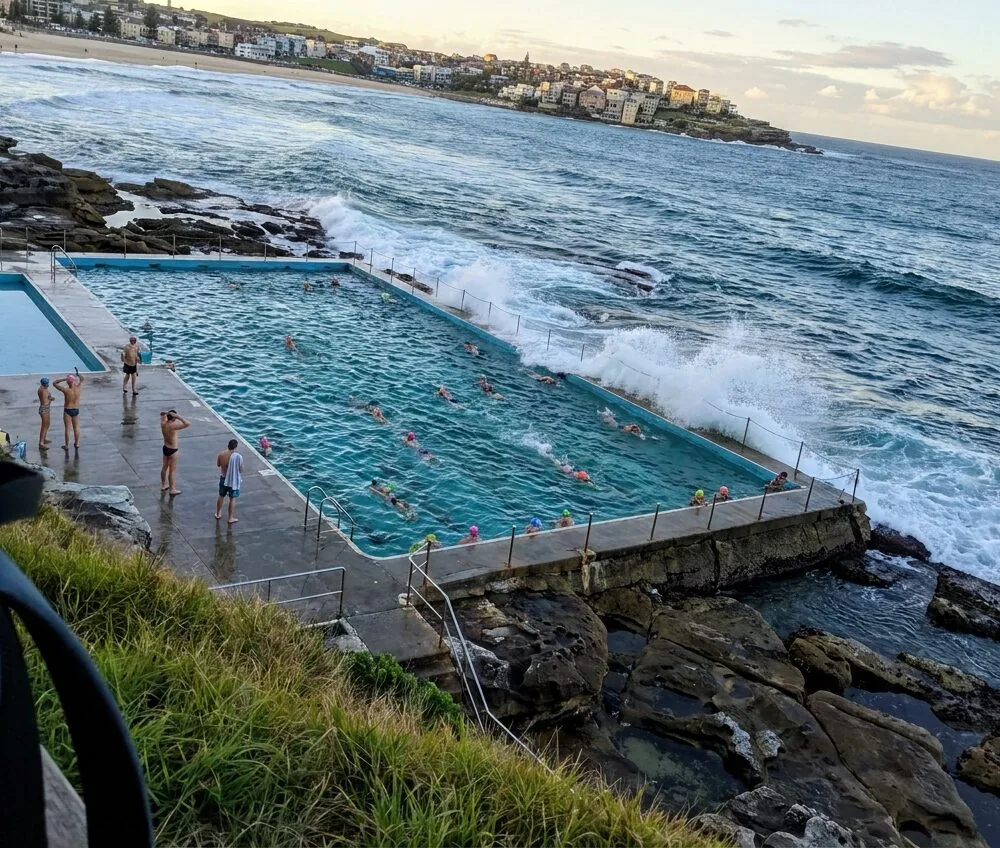
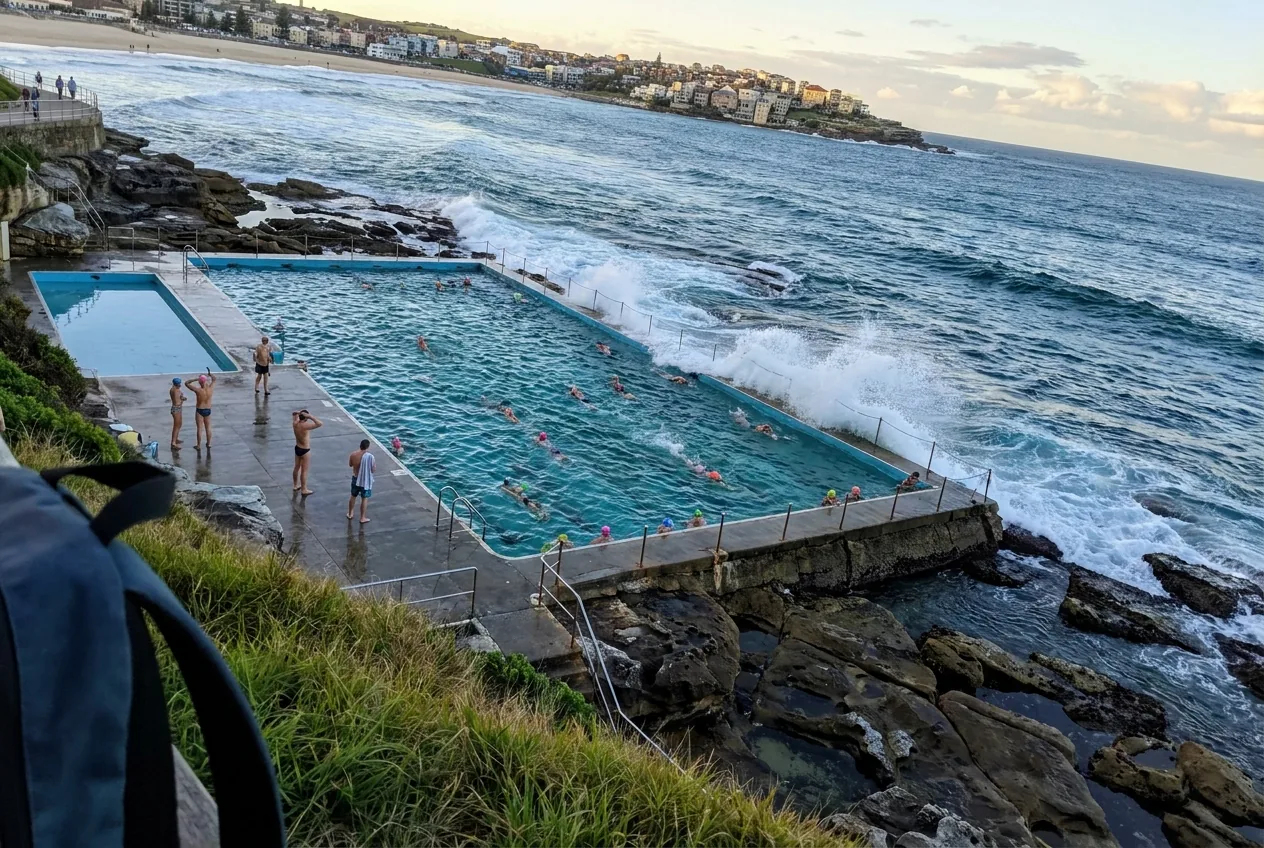
The famous sand is the least interesting reason to come to Bondi. Bondi is the gateway to Sydney’s best coastal walk, the start of a chain of better beaches that runs south for six kilometres, and the home of one of Australia’s most photographed ocean pools. The actual sand is one kilometre of crowded shore wedged between two headlands. Spending a whole day staring at it is not the right move, and most things to do in bondi beach guides skip this part entirely. This is a research briefing on Bondi as locals actually use it — a Bondi Beach guide written from a desk in Casablanca, drawing on Destination NSW’s Sydney pages, Transport for NSW Opal pricing, Waverley Council parking notices, the Bureau of Meteorology Sydney station, and Beach Safe’s daily rip-current data. No partner links, no fabricated cafe names, no padding to hit a word count.
The questions a real visitor actually asks about things to do in bondi beach are simpler than most guides admit. Is Bondi worth visiting. How do you get there. Where do you actually swim. Where do locals eat. We answer those, in that order, with sources you can verify yourself.
The headline answer: Bondi is worth a half day if you treat it as the start of the coastal walk to Coogee, swim only inside the flagged corridor, eat three streets back from the beach, and skip the mid-summer Saturday peak. The rest of this brief is the working-out.
Quick facts
- The actual highlight: Bondi to Coogee coastal walk (6 km, 2–3 hours)
- Cost (full day, per person): AUD 80–150 including transport, food, Icebergs
- Transport: 333 bus from Circular Quay or T4 train + 380 bus
- Best time: Sunrise for Icebergs photos, weekday mornings for fewer crowds
- What to skip: Campbell Parade for food, swimming at southern end (rip current)
What most Bondi Beach guides get wrong
The first mistake in most things to do in bondi beach articles is treating the headline beach as the destination. Bondi is a one-kilometre stretch of crowded sand. The thing worth coming for sits south of it. Tamarama, Bronte, Clovelly, Coogee — four better beaches connected by a six-kilometre coastal walk that most visitors never finish, or never start.
The second mistake is recommending Campbell Parade for food. The waterfront strip is priced for visitors with limited time and limited recourse. A flat white on Campbell Parade runs AUD 7 to 8; the same coffee three streets back on Hall Street or Glenayr Avenue runs AUD 5 to 6. A breakfast on the esplanade is AUD 28 to 35; the same plate at a backstreet cafe is AUD 18 to 25. The three-street walk inland is the cheapest food upgrade in eastern Sydney.
The third mistake is listing Bondi Icebergs without the entry fee. Generic listicles describe Icebergs as a “free swim spot” or “iconic landmark” without mentioning that you pay AUD 10 to swim laps in it. The pool is excellent value at that price; getting surprised at the gate is not. Locker hire is extra. Towels are not provided.
The fourth mistake is ignoring the rip current. Bondi has a documented permanent rip on the southern end called the Backpackers’ Express because of how reliably it catches unprepared overseas visitors. The rip is fast, it is wide, and it pulls strong swimmers offshore in seconds. Lifeguards rescue dozens of people from it every summer. The flagged corridor is the only safe swim zone on the day. Generic guides almost never mention this and visitors die from it. We will mention it loudly: swim between the red-and-yellow flags only.
Is Bondi Beach worth visiting?
The “is bondi beach worth visiting” question gets asked in every visitor forum and the listicle answer is always yes. The honest answer: yes, but only if you understand what it actually is. Bondi is the gateway to one of Sydney’s best coastal walks, the home of an iconic ocean pool, and a real residential neighbourhood that wakes early and runs on beach rituals. It is not a quiet beach, it is not a cheap food destination, and it is not a place to spend a whole day staring at the sand.
The real value of an honest Bondi Beach guide is the southward chain — Tamarama 15 minutes’ walk, Bronte another 10, Clovelly another 15, Coogee at the end — and the morning rituals at Icebergs and the backstreet cafes between Hall Street and Glenayr Avenue. That is the actual list of things to do in bondi beach worth doing. Spend three to five hours, not a whole day. Combine the visit with the rest of Sydney rather than building it as a separate trip.
If you have only 24 hours in Sydney, skip Bondi entirely and stay on the harbour. If you have two days or more, work it in as a half-day morning or afternoon, ideally with the bondi to coogee walk south to Bronte or beyond. Our Sydney 2-day itinerary covers exactly how the half-day fits, and the bondi vs manly decision below explains when to swap to the ferry-and-Manly version of the same day instead.
How to get to Bondi Beach (without driving)
The first practical question on any things to do in bondi beach plan is transit. There is no train station at Bondi Beach itself. The three working access routes from central Sydney:
- Bus 333 from Circular Quay. Direct service, runs every 10 to 12 minutes in peak hours, journey time 30 to 40 minutes. Costs around AUD 5 on Opal depending on time of day. The 333 is the right answer for first-time visitors arriving at the harbour and heading straight to Bondi.
- T4 train to Bondi Junction, then bus 380 down to the beach. The train ride from Central Station is 12 minutes, the bus from Bondi Junction to the beach is 8 to 12 minutes. Total around 25 minutes. Slightly faster than the 333 in peak hours, and you see the neighbourhood as you walk down. Locals’ preferred route.
- Walk down from Bondi Junction. The 1-kilometre downhill walk from Bondi Junction Station to the beach is 15 to 20 minutes, free, and gives you the best orientation to the suburb if you have legs and time.
Opal cap matters here. Sydney’s Opal daily cap sits at AUD 19.30 on weekdays and AUD 9.65 on weekends and public holidays per the Transport NSW fares page. Once you hit the cap, every additional bus, train, ferry, and light-rail trip is free for the rest of the day. Plan a Bondi day around the weekend cap if you can.
Skip driving. Hall Street parking runs AUD 9 per hour and the council carpark above the beach fills by 9am on summer weekends. Fines for expired meters run roughly AUD 180 per Waverley Council notices. Bus or train always wins.
Where to actually swim (and where to skip)
The most-asked things to do in bondi beach question after getting-there is where to swim. Bondi has four distinct swim zones and choosing the right one is the most important decision of the day.
- The flagged surf zone (north end). Lifeguards set the red-and-yellow flags in the safest corridor each morning. This is the only place to swim if you are not a strong, ocean-experienced swimmer. The flagged corridor moves daily based on conditions; it is sometimes near the south end, more often on the north. Read the signs at the beach entrance before walking down.
- Bondi Icebergs pool. A 50-metre saltwater lap pool built into the rocks at the south end. Entry is AUD 10 per adult. Open most days from around 6am to 7pm; closed Tuesdays for cleaning. Lap swim with waves breaking over the seaward edge is not a bad way to spend AUD 10.
- Bronte Baths (one cove south). Free entry. Lane-marked. Naturally flushed by the swell, so water is always fresh. Locals’ pool of choice for daily training swimmers. Open dawn to dusk.
- The North Bondi corner. The protected far-north end of Bondi, sheltered by the headland. The gentlest water on the beach, suitable for kids and nervous swimmers. Walk ten minutes north along the promenade from the south end.
What to skip: the southern end past the flags. The Backpackers’ Express rip current sits there. Beach Safe publishes daily rip warnings for Bondi. If conditions list a rip on the south side, do not swim south of the flags. Tamarama, the next cove, is also a rip-cove with serious surf and is not a beginner swim beach despite being beautiful for photos.
The Bondi to Coogee coastal walk
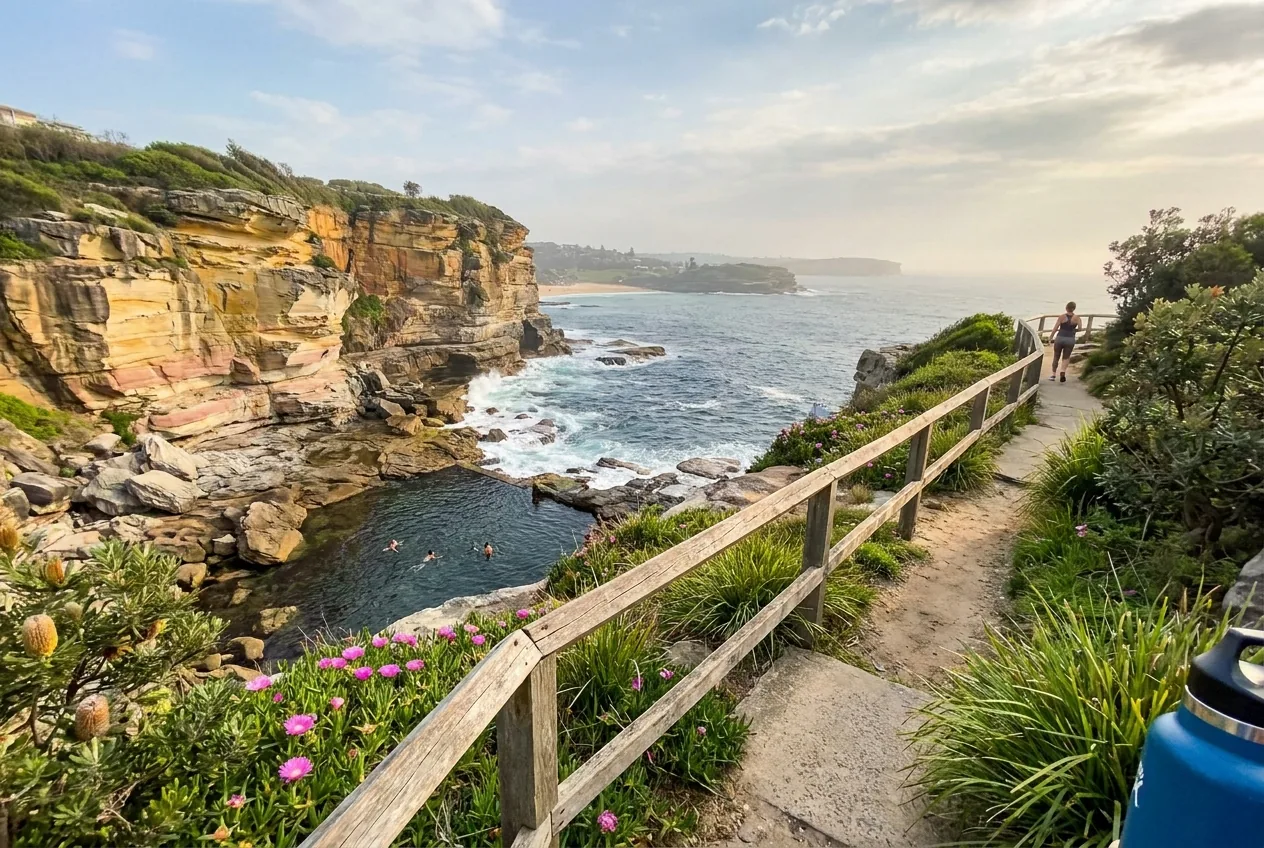
This is the actual highlight of any honest things to do in bondi beach plan. The bondi to coogee walk is six kilometres one way, takes two to three hours at a real walking pace, and connects four beaches and three ocean pools across some of the best sandstone cliff geology on the eastern Australian coast. Most Bondi Beach guide listicles bury it in a single bullet near the bottom; it should be the headline.
Start at Bondi around 8am on a weekday. The first kilometre — Bondi south end up to Mackenzies Bay — is the busy part. The next five kilometres are quieter and more dramatic.
The route, in order:
- Bondi south end (start). Climb the steps past Icebergs onto the cliff path.
- Mackenzies Bay. A small unnamed cove that sometimes has sand and sometimes does not (it shifts with storms).
- Tamarama (15 minutes from start). Narrow rip-cove with serious surf. Photo stop, not a swim stop.
- Bronte (25 minutes from start). Family beach, grassy picnic lawn, free Bronte Baths ocean pool, surf gentle enough for kids. Coffee in Bronte Village two streets back.
- Clovelly (50 minutes). Sheltered rock-lined channel pool. Snorkellers love it. Underrated swim spot if Bronte and Bondi are crowded.
- Gordons Bay. Tiny cove, mostly fishermen. Walk straight through.
- Coogee (1.5 to 2 hours). Full-sized suburban beach with a longer promenade and more food options than Bondi backstreets. Lunch and a swim before catching the bus back.
Total transit cost: zero (walking) plus AUD 5 for the 372 or 373 bus from Coogee back to the CBD. The bondi to coogee walk drops in difficulty after Bronte; if anyone in the group has mobility limits, stop there and bus back.

Bondi Icebergs: is it worth $10?
Yes at sunrise. Yes on a hot weekday morning. Skip on Sunday afternoon.
Icebergs is a 50-metre ocean lap pool built into the rocks at the south end of Bondi. The pool sits roughly five metres above the ocean and water from the surf splashes over the seaward edge constantly. Entry is AUD 10 per adult. Lockers cost extra. Towels are not provided. Open most days 6.30am to 6.30pm; closed Tuesdays for the weekly clean.
When it is worth it:
- Sunrise, especially in summer. The light hits the pool from the east and the lap-swim before the crowd arrives is genuinely transcendent. By 8am the lanes are full.
- Hot weekday afternoons. The pool is cooler than the main beach, the queue is short, and the AUD 10 buys two or three hours of swim-and-rest cycles.
- Winter mornings. Water drops to 16°C in July; the regulars who swim daily are there at 7am in tracksuit pants and the place is almost empty. A cold-plunge day is its own experience.
When it is not:
- Sunday afternoons in summer. The queue at the gate runs to 30 minutes. The pool is full. Big swell sends waves crashing over the seaward edge so hard that lap swimming becomes survival swimming.
- Days with strong easterly wind. The wave-over-the-edge effect amplifies and lap swimming gets actively dangerous.
Bring a towel from your hotel. Pack swimmers and goggles. Cash or card both accepted at the gate.
Bondi vs Manly: which beach for first-time visitors?
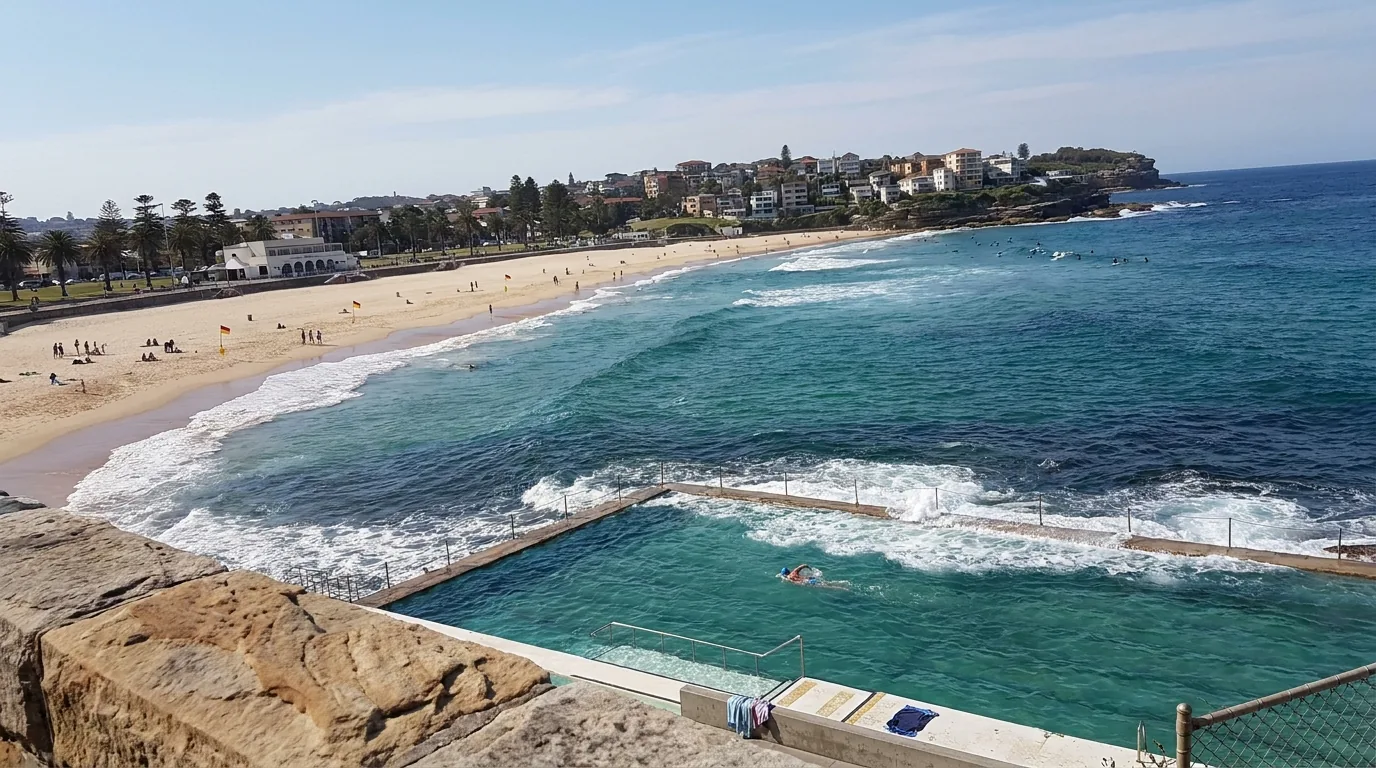
The bondi vs manly question is the most-asked decision in Sydney travel and most articles refuse to actually answer it. The bondi vs manly framing matters because both beaches sit at opposite ends of the harbour mouth and both have their own gravity for first-time visitors. The honest answer: pick by personality, not by checklist, and never try to do both in one day.
Choose Bondi if:
- You want the coastal walk south to Coogee. This is the actual highlight and Manly does not have an equivalent.
- You are a stronger swimmer comfortable reading surf and currents.
- You like a louder, more commercial beach scene with fitness culture and people-watching.
- You are based in Sydney CBD and want a direct half-day option (the 333 bus from Circular Quay is the simplest beach trip in Sydney).
- You want one of Sydney’s iconic photographs (Icebergs at sunrise).
Choose Manly if:
- You want the 30-minute ferry from Circular Quay as the experience itself. The ferry ride across the harbour at sunset is genuinely memorable.
- You are a casual swimmer who prefers calmer water. Shelly Beach (a 5-minute walk from Manly Wharf) is the most-protected family swim beach within reach of central Sydney.
- You prefer a quieter, less commercial feel. Manly has cafes and restaurants but lacks Bondi’s intensity.
- You are already going to Circular Quay for the Opera House or the harbour.
What you should not do: try to fit both Bondi and Manly into a single day on a 2-day Sydney visit. The transit between the two — bus from Bondi back to Circular Quay, then ferry to Manly — burns 90 minutes one way. Half a Saturday lost to transit. Pick one and commit.
Where to eat (three streets back from the beach)
Food is the third most-asked things to do in bondi beach question after getting-there and where-to-swim. Campbell Parade is priced for visitors. Walk three streets inland and the prices drop and the quality usually goes up. The micro-geography that matters:
- Hall Street. The main backstreet café strip, two blocks inland from Campbell Parade. Coffee AUD 5 to 6, breakfast plates AUD 18 to 25, lunch AUD 20 to 30. Bakeries with passable sourdough, cafes with proper espresso, a Saturday morning feel that does not exist on the esplanade.
- Glenayr Avenue. One block further inland from Hall Street. Cheaper still. Smaller cafes, neighbourhood mood, locals’ regulars. Best for second-coffee or mid-afternoon.
- Curlewis Street. Connects Hall Street back toward the beach. Has a couple of cafes with outdoor seating and a slightly residential feel. Pleasant in the late morning.
- Bondi Road. The main artery from Bondi Junction down to the beach. The IGA supermarket here is the cheapest grocery option; a two-person beach picnic packed from this IGA runs about AUD 30, vs roughly AUD 70 for the same lunch on the esplanade.
Skip Campbell Parade for sit-down meals. It is fine for an ice cream or a quick takeaway snack between sand and bus, not for a meal that justifies its bill.
Best time to visit Bondi Beach
The “is bondi beach worth visiting” question is partly a weather question. Bondi is swimmable year-round. The mood changes dramatically by season and time of day per BOM Sydney station data:
- Sunrise in summer (December to February): genuinely the best window of the year. The sand is cool, water is already swim-warm in the low twenties, and the crowd is a handful of surfers and a cleaner walking a dog. By 9am the beach is unrecognisable.
- Midday peak summer: elbow to elbow. Parking is impossible. Skip unless you are there for the people-watching.
- Autumn (March to May): water still 21 to 23°C, crowds thin, light is good. The value-for-experience window of the year.
- Winter (June to August): ocean drops to 16°C. Surfers, walkers, and winter-swimming clubs only. The beach is often silent and empty at sunrise.
- Spring (September to November): warming up, manageable crowds, Saturday markets running. Good for walks, ocean swimming improves through October.
- Sundays year-round: avoid Sunday afternoons in summer. Day-trippers, cruise passengers, and bus tours make the esplanade hard to walk between 1pm and 5pm.
Where to stay near Bondi Beach
Two honest options if you want to base in the area, plus the recommendation most visitors actually need:
- Bondi itself: surf lodges and hostel dorms AUD 50 to 90 a night; one-bedroom apartment rentals AUD 200 to 360; mid-range boutique hotels AUD 240 to 380. Backstreets (Curlewis, Glenayr, Wellington) are quieter than Campbell Parade. Stay here if your trip is five-plus days and you want one of them to feel residential.
- Bondi Junction (10 minutes away by bus): cheaper, less character, more transport options. Useful if you want a Bondi base without the beach-block premium.
- Recommended for most visitors: stay in Sydney CBD instead. Bondi is a half-day or day trip, not a base. The 333 bus is fast, the train-and-walk is faster, and CBD accommodation gives you the harbour, the Opera House, the Botanic Garden and the Inner West restaurants on the same nights. Build Bondi into the trip; do not orbit your trip around Bondi.
What to skip in Bondi
The honest closer for any things to do in bondi beach plan, and the editorial difference between this Bondi Beach guide and the listicles on Google’s first page. These are the four things that cost money or time on every other Bondi guide and are not worth either.
- Skip Campbell Parade for sit-down food. Cafes three streets inland are cheaper and better.
- Skip swimming at the southern end past the flags. The Backpackers’ Express rip is real and dangerous.
- Skip Sunday afternoon Icebergs in summer. Queue at the gate, full pool, dangerous wave-over-edge in heavy swell. Go at sunrise instead.
- Skip driving. Parking is AUD 9 per hour at Hall Street, often full, and fines run AUD 180. Bus or train always wins.
Plan the next leg
Bondi works best as part of a broader Sydney visit, not a standalone trip. Treat the things to do in bondi beach above as half-day cargo on a Sydney itinerary, not the trip itself. The full visa-flights-routing planning frame for a longer Australia trip is in our how to plan a trip to Australia brief. The natural pairing is the Sydney 2-day itinerary, which builds Bondi into Day 2 Option A (Coastal day). North up the coast, the Sydney to Byron Bay road trip is the next NSW weekend to book. The broader regional context is in the Sydney destination archive and the New South Wales destination archive. For the official picture, Destination NSW’s Bondi page is the government-authority source. The Saltrove newsletter catches the next regional brief.
M. Saltrove is the editor of Saltrove. Based in Casablanca, Morocco, M. researches Australian travel from primary sources — government data, weather records, traveler reports — and writes from a desk, not a campervan. Each article notes whether it is a field report or a research briefing. This piece is a research briefing.
Frequently asked questions
Is Bondi Beach worth visiting?
Yes, but only as a half-day stop, not a full-day destination. Bondi is the gateway to one of Sydney's best coastal walks (the 6 km Bondi-to-Coogee), the home of Bondi Icebergs ocean pool, and a real residential neighbourhood with backstreet cafes that cost half the esplanade prices. It is not a quiet beach or a budget food destination. If you have only 24 hours in Sydney, skip Bondi and stay on the harbour. If you have 2+ days, work it in as a half-day morning with the coastal walk south to Bronte or Coogee.
How do you get to Bondi Beach from Sydney CBD?
Three working routes: bus 333 from Circular Quay direct (30-40 minutes, AUD 5 on Opal); T4 train to Bondi Junction then bus 380 down to the beach (about 25 minutes total — locals' preferred route); or T4 train to Bondi Junction and walk the 1 km downhill (15-20 minutes). Sydney's Opal daily cap is AUD 19.30 weekday and AUD 9.65 weekends and public holidays per Transport NSW. Skip driving — Hall Street parking is AUD 9 per hour, often full, with AUD 180 fines for expired meters.
Is Bondi Icebergs pool worth $10?
Yes at sunrise, yes on a hot weekday morning, skip on Sunday afternoon. Icebergs is a 50-metre saltwater lap pool built into the rocks at the south end of Bondi, open most days 6.30am to 6.30pm (closed Tuesdays for cleaning). Entry is AUD 10 per adult; lockers extra; towels not provided. The lap-swim before the crowd arrives is genuinely worth the fee. Avoid Sunday afternoons in summer (queue at the gate, full pool, dangerous wave-over-edge in heavy swell).
Is Bondi Beach safe to swim?
Only between the red-and-yellow flags. Bondi has a documented permanent rip current on the southern end called the Backpackers' Express because of how reliably it catches unprepared overseas visitors. The rip pulls strong swimmers offshore in seconds; lifeguards rescue dozens of people from it every summer. The flagged corridor is the only safe swim zone on the day — its position moves daily based on conditions. Read the signs at the beach entrance and check Beach Safe's daily rip warnings before entering the water.
Should you visit Bondi or Manly?
Pick one — never try to do both in one day. Choose Bondi if you want the coastal walk south to Coogee (the actual highlight, no Manly equivalent), are a stronger swimmer comfortable with surf, and prefer a louder more commercial scene. Choose Manly if you want the 30-minute ferry from Circular Quay as the experience itself, prefer calmer water (Shelly Beach is family-friendly), and like a quieter feel. The transit between the two burns 90 minutes one way through Circular Quay, so attempting both in a 2-day Sydney visit means losing half a Saturday to buses and ferries.
How long is the Bondi to Coogee walk?
Six kilometres one way, two to three hours at a real walking pace. The coastal walk passes Tamarama, Bronte, Clovelly, Gordons Bay, and ends at Coogee — four beaches, three ocean pools, and some of the best sandstone cliff scenery on the east Australian coast. Start at Bondi around 8am on a weekday for the quietest section. The walk drops in difficulty after Bronte (about 25 minutes in); if anyone in the group has mobility limits, stop there and bus back. Total cost: zero for the walk, plus AUD 5 for the 372 or 373 bus from Coogee back to the CBD.
Where should you eat near Bondi Beach?
Three streets back from Campbell Parade. Hall Street is the main backstreet cafe strip — coffee AUD 5-6, breakfast AUD 18-25, lunch AUD 20-30 (vs AUD 7-8 coffees and AUD 28-35 breakfasts on the esplanade). Glenayr Avenue, one block further inland, is cheaper still. The IGA supermarket on Bondi Road is the cheapest grocery option for a beach picnic — AUD 30 for a two-person lunch packed there vs AUD 70 for the same meal on the esplanade. Skip Campbell Parade for sit-down meals; it is fine for an ice cream or quick takeaway snack only.
What's the best time of day to visit Bondi?
Sunrise. The sand is cool, water is already swim-warm in summer, and the crowd is a handful of surfers and a cleaner walking a dog. By 9am the beach is unrecognisable. Best season: autumn (March to May) when water still sits at 21-23°C and crowds thin. Worst window: midday peak summer Saturdays and Sunday afternoons year-round (cruise passengers, day-trippers, and bus tours make the esplanade hard to walk between 1pm and 5pm). Winter (June to August) drops ocean temperature to 16°C; the beach is often silent and empty at sunrise — best for walks and Icebergs lap swims rather than ocean swimming.