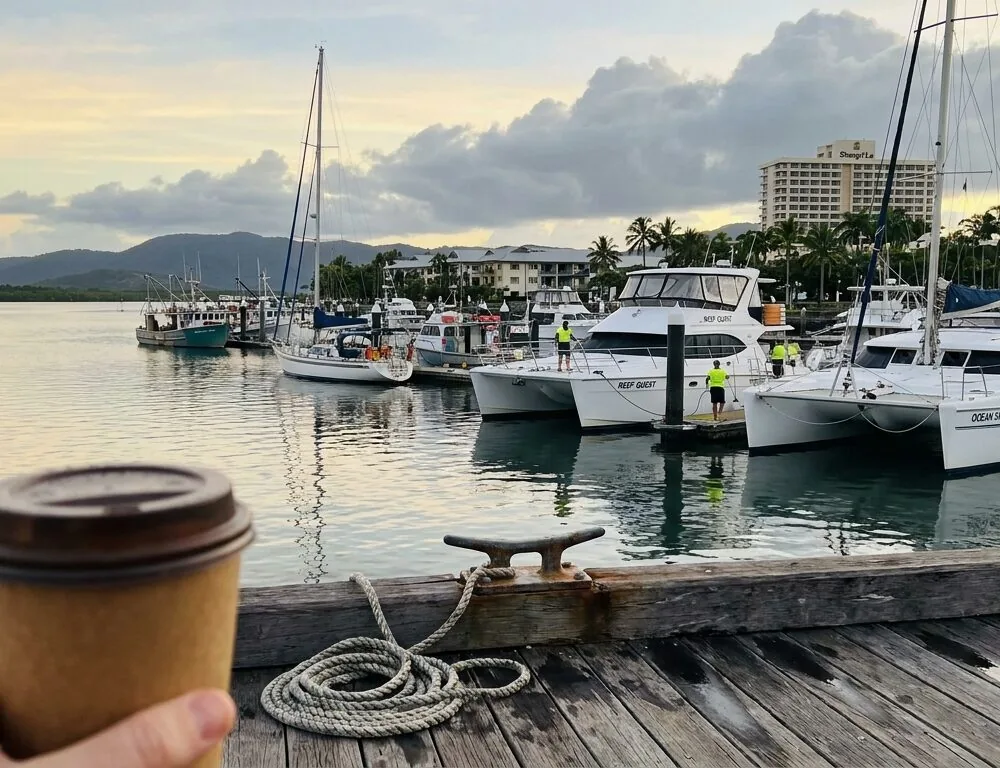
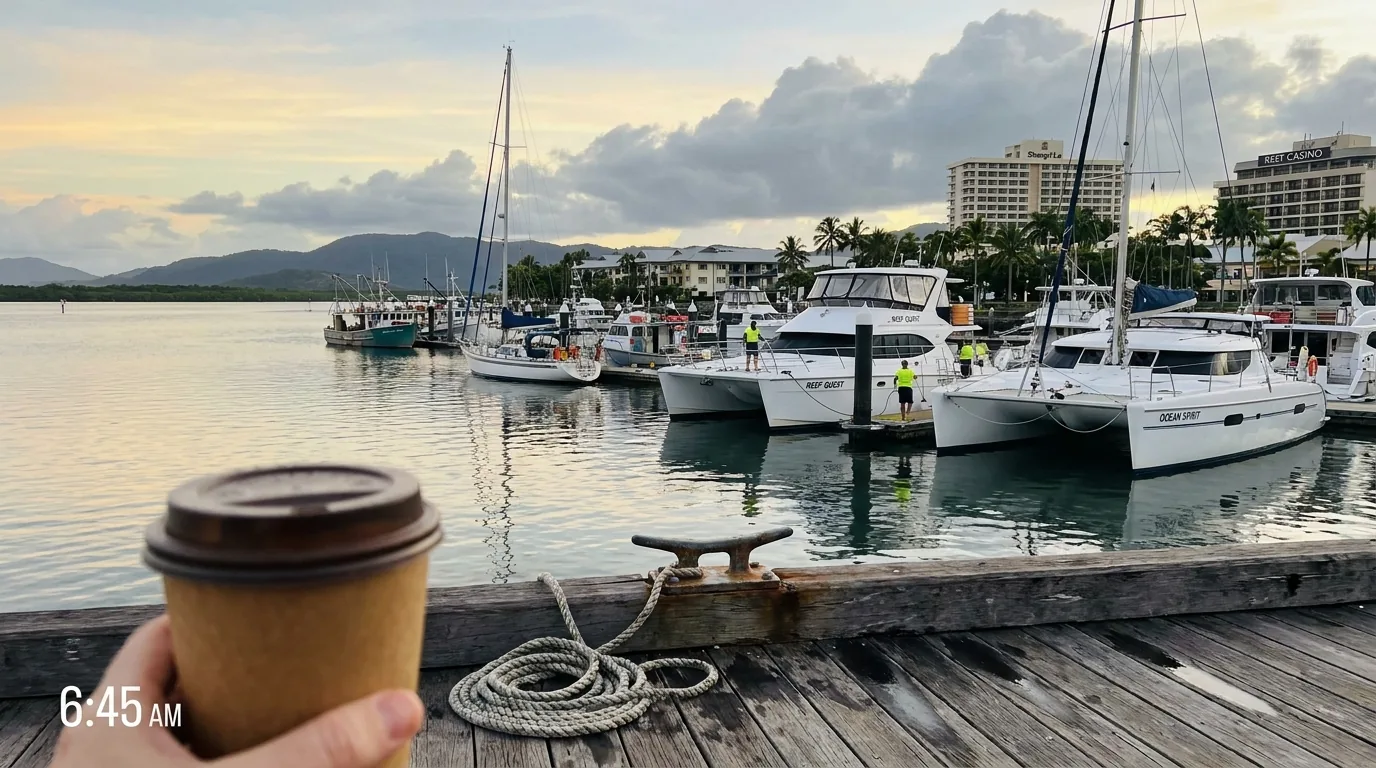
The Cairns to Brisbane drive usually gets written up as a theme-park brochure or an affiliate best-of list. We went the other way. This is a research briefing on the Cairns to Brisbane drive, written from a desk in Casablanca, drawing on Tourism and Events Queensland’s regional pages, Bureau of Meteorology tropical-station records, the Great Barrier Reef Marine Park Authority, and Tourism Australia’s tropical-north resources. No partner links, no fabricated reef-boat reviews.
The questions a real visitor asks about the best places to visit in Queensland are simpler than most guides admit. How long does the coastal drive really take. What does it cost. When is the weather honest. Which stops are worth the overnight, and which is everyone pretending is worth it because it sponsors the article. We answer those in that order, with sources you can verify.
The route is 1,700 kilometres door to door — closer to 2,000 with the detours that make the trip worth taking. Seven days is the floor; more and you are paying for nights in Mackay you did not need. The best places to visit in Queensland for a first-time road-tripper sit on this stretch in a sequence that almost designs itself.
Quick facts
- Distance: 1,700 km Cairns → Brisbane (2,000 km with detours)
- Cost (7 days, mid-range, per person): AUD 2,700–3,700 excluding flights
- Best time: May–October (dry season, peak July–September)
- Drive time: 20 hours total, split across 7 days
- What to skip: Townsville (unless stopping for fuel), Surfers Paradise
What most Queensland guides get wrong
The first thing most Queensland road-trip articles get wrong is suggesting you fly between Cairns and Brisbane. The drive is 1,700 kilometres — further than London to Rome — and a 2.5-hour flight covers it for AUD 180 to 380 return. But flying skips the trip itself: the reef gateway, the Whitsundays, the Sunshine Coast. The queensland from cairns to brisbane drive is the article, and several of the best places to visit in Queensland sit between the endpoints rather than at them. If you do not want the drive, you do not want this trip; book the flight and stay in Cairns instead.
The second mistake is treating the Whitsundays as optional. They sit dead-centre on the route — Airlie Beach is roughly the geographic midpoint between Cairns and Brisbane — which makes skipping them harder than including them. Day-sailing trips to Whitehaven run AUD 200 to 280 per person; scenic flights over Heart Reef and the Hill Inlet swirl run AUD 200 to 350. Either way, you are an hour off the Bruce Highway, not a flight away.
The third mistake is planning around Brisbane in summer. December to February is wet season in tropical Queensland and storm season across the southeast. The Great Barrier Reef Marine Park Authority’s reef condition pages consistently note reduced visibility through the wet, and the Bruce Highway sees regular flood closures north of Townsville. Queensland in summer is the weakest version of this trip; it is also when most international visitors mistakenly try it.
The fourth mistake is lumping the Sunshine Coast in with the Gold Coast. They are different places. The Sunshine Coast is quieter, more expensive, more food-focused, and ends at Noosa Heads National Park. The Gold Coast is louder, cheaper per night, and built around theme parks. A road trip ending in Brisbane passes through the Sunshine Coast and ignores the Gold Coast; treating them as substitutes is how travellers end up disappointed with both.
Is Queensland worth visiting?
Yes, but only on the right schedule. Queensland rewards visitors who match the season to the geography — dry season for the reef, dry season for the highway, dry season for rainforest walks that are otherwise leech-friendly mud. In the wrong season, the same trip turns into a sequence of cancelled reef days, overcast highway driving, and stinger-net swimming.
Is Queensland worth visiting in the dry season? Without reservation. Between May and October the tropical north sits at 22 to 28°C with low humidity, the reef is at its clearest, the Whitsundays are sailable, and the Bruce Highway is reliably open. The southern half — Sunshine Coast and Brisbane — runs cooler and is at its most pleasant for walking and eating without sweating through your shirt by 9am.
Is Queensland worth visiting in the wet? With caveats. November to April covers cyclone season in the tropical north, irukandji and box-jellyfish risk on most beaches, and storm-driven highway closures further south. Operators cancel reef days more often than they run them in February. The honest answer is that Queensland in summer is the weakest version of this trip, and many of the best places to visit in Queensland — particularly outdoor ones — read very differently in the rain.
Best time to drive Cairns to Brisbane
The dry season — May through October — is the entire answer for this drive. Within that window, July through September is the sweet spot: the Bureau of Meteorology Queensland regional forecasts show the lowest rainfall and the most stable visibility for the tropical north, while Brisbane and the Sunshine Coast sit in their cool-and-clear best at 18 to 24°C. Most of the best places to visit in Queensland — the reef in particular — are season-sensitive in a way the marketing rarely admits.
Queensland in winter barely registers as winter at all. June to August in Cairns is 26°C with no humidity; the same months in Brisbane are 20 to 22°C with overnight lows around 10°C. For Northern Hemisphere readers escaping their own winter, queensland in winter is essentially the trip’s peak window — warm enough for the reef, cool enough for the southern walks, with school holidays running only two weeks in late June rather than the long Christmas-January block.
Avoid the Australian school-holiday peaks where you can. The mid-year break (late June to mid-July), the September-October break, and the December-January summer break all push accommodation up 30 to 50 per cent across the Whitsundays and Sunshine Coast. Queensland in winter outside those windows is cheaper than NSW or Victoria on the same dates.
The window to actively avoid is January and February. Tropical cyclone activity peaks in those months, the Tourism and Events Queensland regional advisories note near-weekly operator cancellations in the wet, and the highway between Cairns and Townsville sees regular flood closures.
What this 7-day Queensland itinerary actually costs
A queensland itinerary 7 days long, mid-range, costs roughly AUD 2,700 to 3,700 per person excluding the flight to Cairns. Cross-checked against Tourism Australia’s Cairns and tropical-north regional page and broader Tourism Australia daily-spend figures:
- Car hire (small SUV from Cairns Airport, 7 days): AUD 60 to 90 per day, AUD 420 to 630 total. One-way drop at Brisbane Airport adds AUD 200 to 350.
- Fuel: 1,700 km plus detours is roughly 2,000 km. At 7 L/100 km and AUD 1.85 per litre, that is AUD 260.
- Accommodation (mid-range, 6 nights): AUD 180 to 260 per night, AUD 1,080 to 1,560 total. Airlie Beach and the Sunshine Coast skew the upper end; Mackay and Hervey Bay pull the average down.
- Food (mid-range, 7 days): roughly AUD 80 per person per day, AUD 560 total.
- Activities: an Outer Reef day-trip (AUD 220 to 300), a Whitsundays sailing day (AUD 200 to 280), an optional scenic flight over Heart Reef (AUD 200 to 350), Fraser Coast and Noosa walks (free). Allow AUD 400 to 700 across the week.
That puts a solo mid-range traveller at AUD 2,700 to 3,700 for the week. Couples splitting accommodation drop to AUD 2,100 to 2,700 per person. Backpacker version — hostels, supermarket breakfasts, one reef trip, no scenic flight — lands closer to AUD 1,500. A queensland itinerary 7 days long is pricier than its NSW equivalent because the reef and Whitsundays have no cheap substitutes; both are core, neither is free.
The line item to negotiate hardest is the one-way car-hire fee. Booking eight to ten weeks ahead and comparing operators at Cairns often takes 25 to 30 per cent off the daily rate.
The 7-day Cairns to Brisbane road trip itinerary
The full queensland from cairns to brisbane drive splits into four driving days plus three stationary days at the major activity stops. Day-by-day distances and overnights below.
Days 1-2: Cairns and the Great Barrier Reef
Two days is enough to cover the city plus a Reef day-trip. Land at Cairns Airport, take the airport shuttle into town, drop bags at an Esplanade hotel. Day one is an arrival day: the Cairns Esplanade lagoon (free, lifeguarded), the Cairns Botanic Gardens, an early dinner on Spence Street. Day two is the reef day — and the reef is one of the best places to visit in Queensland regardless of which itinerary brings you there. Outer Reef tours from Cairns Marina run AUD 220 to 300 per person and are a full-day commitment from 7am to 5pm. Our Great Barrier Reef budget guide walks through operator selection and inner-versus-outer-reef trade-offs; our Cairns guide covers the city-side logistics.
Pick up the rental car on the morning of day three. There is no benefit to a car in Cairns itself — accommodation is walkable to the Esplanade and reef boats depart from Marlin Marina either way.
Day 3: Cairns to Airlie Beach
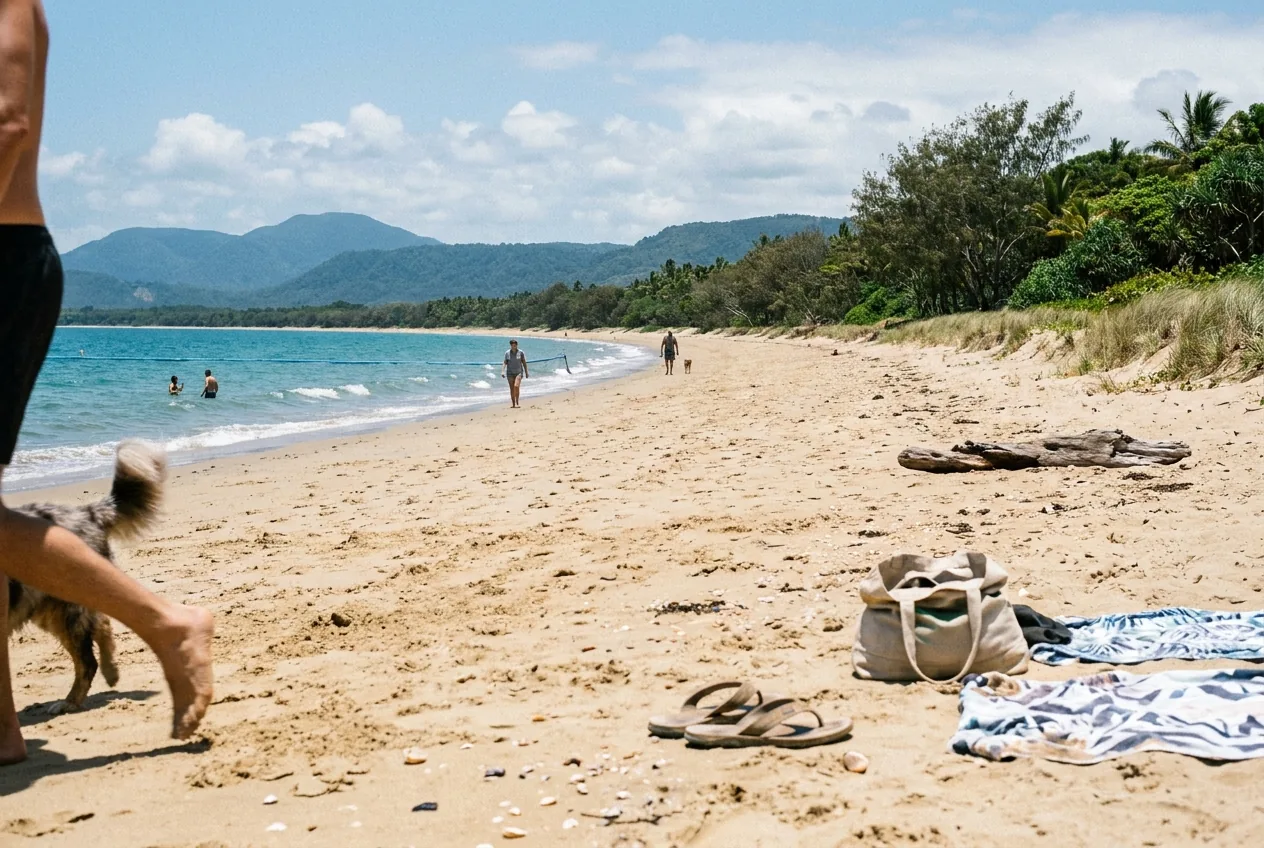
Eight hours of Bruce Highway — the hardest single day on the route, be honest about it. Leave Cairns by 8am, stop at Mission Beach for lunch (the cassowary signs are not decorative), bypass Townsville rather than detouring in, arrive Airlie Beach by 6pm. The bypass adds ten minutes; the detour adds two hours.
Airlie Beach is a small Whitsundays gateway with a marina, a lagoon pool similar to Cairns’, and one main street of restaurants. Stay two nights so day four is a sailing day rather than sailing-and-driving.
Day 4: Whitsundays sailing day
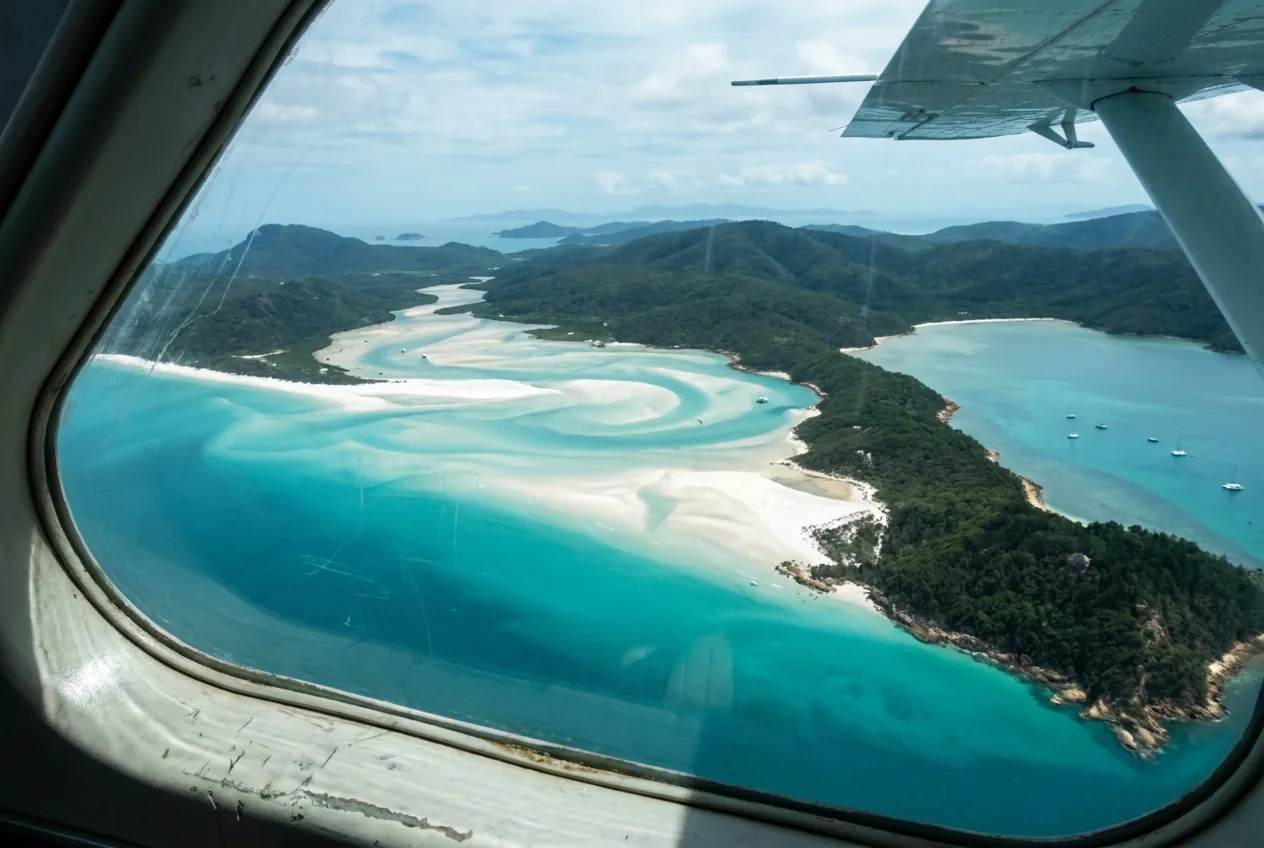
A full day on the water. Day-sailing trips depart Abel Point Marina at 8am and return by 5pm, costing AUD 200 to 280 per person including snorkel gear and lunch. The route covers Whitehaven Beach — silica sand fine enough that Australian airlines used it for hourglasses through the 1960s, and one of the best places to visit in Queensland on any timeline — the Hill Inlet lookout walk, and at least one snorkel stop on the fringing reef. The Whitsundays are a state Marine Park — operator regulation is tight, water clarity is consistently excellent through the dry season, and resident sea-turtles have near-100 per cent sighting rates.
The optional add-on is a scenic flight over Heart Reef. AUD 200 to 350 for a 60-minute seaplane or helicopter tour. Heart Reef is only visible from above, and most photographs you have seen of the Whitsundays are taken from a similar flight. Worth it once.
Day 5: Airlie Beach to Hervey Bay
Eight hours, tied with day three for the longest leg on the queensland from cairns to brisbane drive. Leave Airlie Beach by 8am, push through Mackay with a coffee stop only — Mackay is a working sugar-and-coal town that pays no dividend on an overnight — and reach Hervey Bay by 6pm. The Bruce Highway south of Mackay is dual-carriageway, fuelled every 80 to 120 kilometres.
Hervey Bay is the gateway to K’gari (formerly Fraser Island), the largest sand island on earth. Travellers with a spare day extend for a 4WD K’gari tour (AUD 220 to 320 per person). On the 7-day pace it is a one-night transit stop; book a beachfront motel and have an early dinner on the Esplanade.
Day 6: Hervey Bay to Sunshine Coast
Three hours of mostly two-lane highway, 250 kilometres. This is the trip’s exhale. The Sunshine Coast runs from Caloundra to Noosa Heads; the road-trip default is to stay in Noosa, within walking distance of Noosa National Park’s coastal track — three kilometres to the headland, dolphins resident at Tea Tree Bay most mornings. The Eumundi market (Wednesday and Saturday mornings, 30 minutes inland) is the regional set-piece if your timing works.
Mooloolaba and Caloundra are cheaper alternatives south. Neither as walkable as Noosa.
Day 7: Sunshine Coast to Brisbane
Ninety minutes south of Noosa. Brisbane is underrated by international tourists and overrated by Australians from Sydney and Melbourne; the truth sits between. South Bank Parklands, Streets Beach (a free chlorinated lagoon in the cultural precinct), the Story Bridge sunset walk, and the Kangaroo Point Cliffs are the canonical first-day stops. The CityCat ferry runs the Brisbane River for AUD 3.55 a ride and is the cheapest scenic ride in any Australian capital.
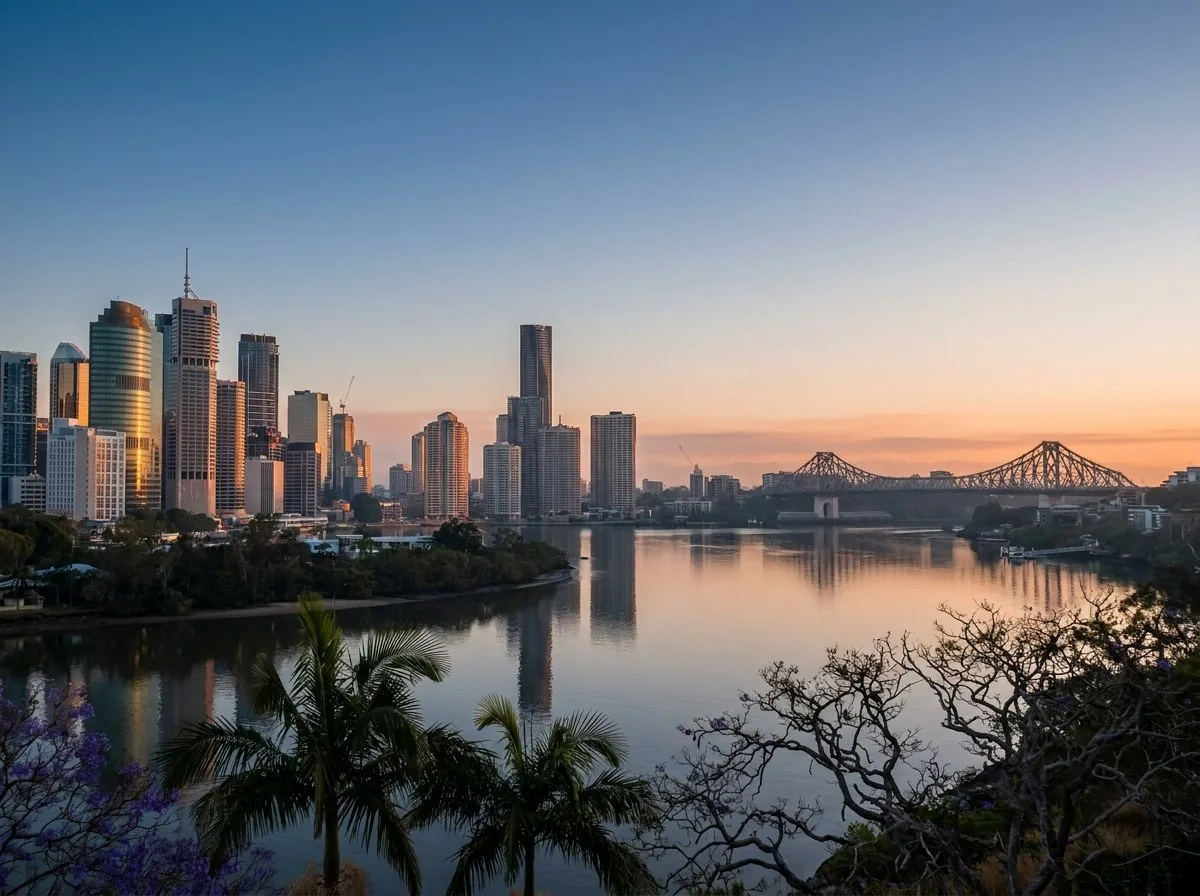
The defining moment of the queensland from cairns to brisbane drive is the Brisbane skyline from the Kangaroo Point Cliffs at golden hour, Story Bridge framing the river bend. Park there, walk the cliff-top path, let the trip close itself out.
Best places to visit in Queensland (beyond the drive)
The 7-day route covers the coastal spine — reef, Whitsundays, Sunshine Coast, Brisbane — but skips the inland and the south. For travellers extending the trip or planning a return visit, the best places to visit in Queensland off the road-trip route sort cleanly by intent.
For an extra two or three days, the Daintree Rainforest is 90 minutes north of Cairns. The Daintree is the oldest continuously surviving rainforest on earth, listed under the Wet Tropics World Heritage area, with cassowary populations and self-drive boardwalk trails. Add it before day three rather than after.
For winter travellers prepared to drive long distances, Outback Queensland — Longreach, Winton, Barcaldine — opens up between May and September. Daytime 22 to 28°C, rainfall negligible, and the Australian Stockman’s Hall of Fame plus the dinosaur trackways at Lark Quarry justify the detour. Avoid October to March.
For families, the Gold Coast is an hour south of Brisbane, built around theme parks, surf beaches, and the Springbrook hinterland. Our Gold Coast itinerary covers the pacing; treat it as a separate add-on, not a same-trip day.
For solitude, Lady Elliot Island at the southern tip of the Great Barrier Reef takes day-trippers and overnight guests via short charter flight from Hervey Bay. Less commercial than the northern reef, manta rays in winter, the highest density of accessible reef sites of any single island. One of the best places to visit in Queensland for travellers who want the reef without the day-tour crowd. Expensive and worth it.
These four sit on the long list of best places to visit in Queensland once the road trip is done.
Where to spend, where to skip
Editorial opinions, after the dollar breakdown.
Spend on an Outer Reef day-trip rather than an inner-reef or Green Island half-day. The outer reef is where visibility, reef-fish density, and genuinely unbleached coral live; the inner reef is where budget operators go to save fuel.
Skip Townsville unless you are stopping for fuel. Working port city, one good beach (the Strand), Magnetic Island offshore — deserves a separate trip, not a Bruce Highway detour on a tight road-trip schedule.
Spend a Whitsundays sailing day. There is no cheap substitute for Whitehaven Beach and Hill Inlet — the Whitsundays are one of the best places to visit in Queensland for first-timers regardless of route.
Skip the highway towns between Mackay and Hervey Bay. Marlborough, Rockhampton, Gladstone, and Maryborough are working regional towns with limited tourism infrastructure; eat at the bakery, fuel up, move on.
Spend the drive into Brisbane via the Kangaroo Point Cliffs rather than going straight to your hotel. The skyline at golden hour is the canonical end-of-trip moment.
Skip Surfers Paradise unless you are travelling with small children. Loud, expensive, built for a different traveller than this article is written for.
Plan the next leg
The Cairns to Brisbane road trip is the northern half of Australia’s most-driven coastal stretch. South of Brisbane the Pacific coast continues into NSW — the Tweed, Byron, Coffs, the Hunter Valley, Sydney — and our companion piece on the Sydney to Byron Bay road trip in NSW covers the southern half for a longer Cairns-to-Sydney run.
For first-time visitors planning the broader trip, the Saltrove guide on how to plan a trip to Australia walks through visa, flights, and route-pairing. Saltrove publishes more regional briefs through the year; the newsletter catches the next one.
M. Saltrove is the editor of Saltrove. Based in Casablanca, Morocco, M. researches Australian travel from primary sources — government data, weather records, traveler reports — and writes from a desk, not a campervan. Each article notes whether it is a field report or a research briefing. This piece is a research briefing.
Frequently asked questions
How long does it take to drive Cairns to Brisbane?
Roughly 20 hours of driving across 1,700 kilometres of Bruce Highway. Doable in three days flat-out; not recommended. Seven days is the version that lets you stop properly at the reef, the Whitsundays, and the Sunshine Coast. The queensland from cairns to brisbane drive is paced for seven days for that reason.
Should you drive Cairns to Brisbane or fly?
Depends on your time budget. Driving is the trip itself — the reef gateway, the Whitsundays, the Fraser Coast, the Sunshine Coast — across seven days. Flying is a 2.5-hour shortcut that skips 1,700 kilometres of coast for AUD 180 to 380 return. If you have fewer than five days total, fly Cairns to Brisbane on day four and stay longer in Cairns; the road trip does not compress well into a long weekend. If you have seven days or more, drive — the best places to visit in Queensland are on the highway between the two cities, not at the endpoints.
Is Queensland worth visiting in winter?
Yes, more so than in summer. Queensland in winter (June to August) is mild on the southeast coast at 18 to 22°C and pleasantly warm in the tropical north at 22 to 28°C. The dry season clears the reef, the Bruce Highway runs reliably, and accommodation pricing sits below the December-January peak. For Northern Hemisphere readers escaping their own winter, queensland in winter is the peak window for this drive.
What's the best month for the Cairns to Brisbane drive?
August or September. Lowest rainfall, clearest reef visibility, mildest highway driving conditions. June and July work too but coincide with the Australian mid-year school holidays, which lift accommodation pricing 30 to 50 per cent. Avoid January and February — wet season, cyclone risk, and regular Bruce Highway closures north of Townsville.
How much does a 7-day Queensland itinerary cost?
A queensland itinerary 7 days long, mid-range, runs roughly AUD 2,700 to 3,700 per person excluding the international flight. Couples splitting accommodation drop to AUD 2,100 to 2,700 per person. Backpacker version (hostels, one reef trip, skipped scenic flight) is closer to AUD 1,500. Reef-day and Whitsundays activities are core to the trip and are the line items least negotiable on price.
Can you do the Great Barrier Reef in one day?
Yes — most reef visitors do. A standard outer-reef day-trip from Cairns is 7am to 5pm, includes two snorkel stops at different sites, and costs AUD 220 to 300 per person including gear and lunch. A liveaboard 2-to-3-day trip covers more ground and gets you into night dives, but is not necessary for most first-time visitors.
Is the Whitsundays worth the detour?
It is not really a detour — Airlie Beach is on the Bruce Highway and one of the geographic midpoints between Cairns and Brisbane. Skipping the Whitsundays on a 7-day Cairns-to-Brisbane drive means driving past one of the best places to visit in Queensland for a town with nothing distinctive to offer. Take the day.
Where should you stay in Brisbane?
South Bank or Fortitude Valley for first-time visitors. South Bank for walkable access to the cultural precinct, Streets Beach, and the riverside ferries; Fortitude Valley for late-night food and bar culture. Both sit at AUD 200 to 320 per night mid-range. New Farm and Kangaroo Point are quieter alternatives within a short ferry ride.